
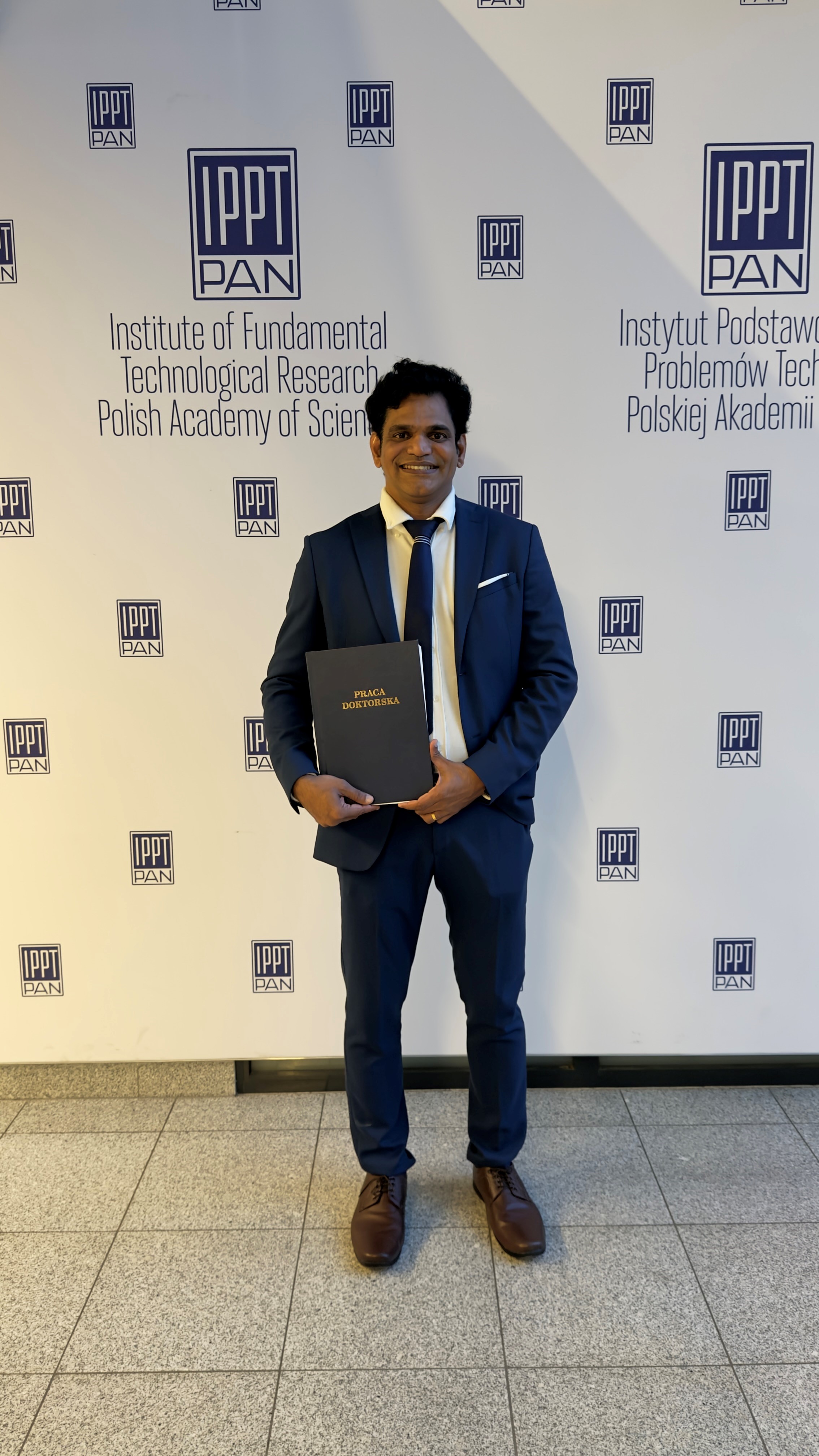
We are pleased to announce that the Scientific Council of the IPPT PAN has awarded Sequeira Anil Antony the degree of Doctor in Engineering and Technical Sciences, in the discipline of Mechanical Engineering. The title of his dissertation is: Thermal properties and thermal residual stresses in graded Al–matrix composites reinforced with Al₂O₃ and SiC particles: Experiments and Numerical simulations.The dissertation was supervised by Prof. prof. Michał Basista, with Assoc. Prof. Witold Węglewski of IPPT PAN serving as assistant supervisor.
Functionally graded materials (FGMs) based on aluminum alloys, which are the subject of this thesis, are advanced metal matrix composites designed for high–stress, high–temperature operating conditions that offer superior performance of structural components due to gradual spatial variation of mechanical and thermal properties of these materials. The motivation for investigating the thermal properties and thermal residual stresses of graded Al–matrix composites reinforced with Al₂O₃ and SiC ceramic particles stems from the automotive industry's demand for innovative structural materials for brake discs. Graded Al–matrix composites are competitive material choices for modern brake discs due to their high specific strength, high thermal conductivity, and wear resistance. A properly designed graded structure of Al/Al₂O₃ and Al/SiC FGMs can help reduce process–induced thermal residual stresses and effectively dissipate heat generated during brake operation. The choice of two alternative ceramic particles (Al₂O₃ vs. SiC) for the reinforcement of an Al alloy matrix was inspired by similar studies carried out in the research laboratories of car manufacturers (e.g., CR FIAT and Audi).
In this work, stepwise graded (or layered) aluminum alloy matrix composites AlSi12+vAl₂O₃ and AlSi12+vSiC, where v = 10, 20, 30 vol.%, were prepared using powder metallurgy. The powder mixtures of AlSi12, Al₂O₃ and SiC used to obtain composite layers and FGMs were prepared in a planetary ball mill. Hot pressing (HP) and spark plasma sintering (SPS) were used as powder consolidation techniques. Microstructural characterization was performed using scanning electron microscopy (SEM) and microcomputed X–ray tomography (micro–XCT). The thermal conductivity of composite layers and FGMs was evaluated using the laser flash technique within a temperature range that is relevant to brake disc application (from RT to 300°C–500°C). The coefficient of thermal expansion (CTE) was determined for a case study of AlSi12+vSiC composites from dilatometry experiments for RT to 500°C. Thermal residual stresses were measured using neutron diffraction. Additionally, Taber linear abrasion wear tests were conducted to evaluate the tribological properties of the AlSi12+vAl₂O₃ and AlSi12+vSiC composites and compare them with grey cast iron, a standard material used in brake discs.
The optimization of the powder mixing and consolidation process parameters has yielded composite layers and FGMs of high relative density. Overall, the samples manufactured by HP were less porous than the SPS samples and the AlSi12+vAl₂O₃ composites were less porous than AlSi12+vSiC composites. The thermal conductivity measurements showed that the ungraded composites exhibited lower conductivity with increasing ceramic content for both AlSi12+vAl₂O₃ and AlSi12+vSiC composites. For AlSi12+vAl₂O₃ composites, porosity and interfacial thermal resistance were identified as the key factors reducing thermal conductivity. In the case of AlSi12+vSiC composites, the formation of thin layers of oxides (Al2O₃), and interfacial thermal resistance were the main contributors to this reduction. The graded composites exhibited nearly constant thermal conductivity across the tested temperature ranges, achieving thermal conductivity that is at least twice that of conventional gray cast iron. This renders them a promising candidate for use in brake disc applications.
Micro–XCT–based finite element (FE) models, representing the actual microstructure, including defects such as pores, and accounting for thermal conductance at the metal–ceramic interface, were used in the numerical simulations. Numerical simulations of thermal conductivity showed excellent agreement with the experimental data, with relative errors ranging from 4% to 6%. Thermal residual stresses were found to be lower in graded composites compared to ungraded ones, as confirmed by neutron diffraction measurements. The micro–XCT–based FEM models predicted residual stresses with an accuracy of less than 5% deviation from the experimental data.
Dilatometric experiments revealed that the coefficient of thermal expansion (CTE) in the direction parallel to the pressing direction of graded composites was significantly lower than that in the direction perpendicular to the pressing direction. Overall, the graded composites demonstrated a favorable CTE, approximately 32% lower than that of the aluminum alloy (AlSi12) matrix, indicating enhanced thermal stability and suitability for applications requiring minimal dimensional changes under varying temperature conditions.
This study successfully investigated the thermal properties, thermal residual stresses, and tribological performance of graded AlSi12–matrix composites reinforced with Al₂O₃ and SiC particles, combining experimental and numerical approaches. The findings highlight the potential of functionally graded composites as high–performance materials for automotive brake discs, offering superior thermal conductivity, reduced residual stresses, enhanced thermal stability. The agreement between the experimental and numerical results validates the robustness of the proposed numerical models, helping in further exploration and application of graded composites in industrial settings.