
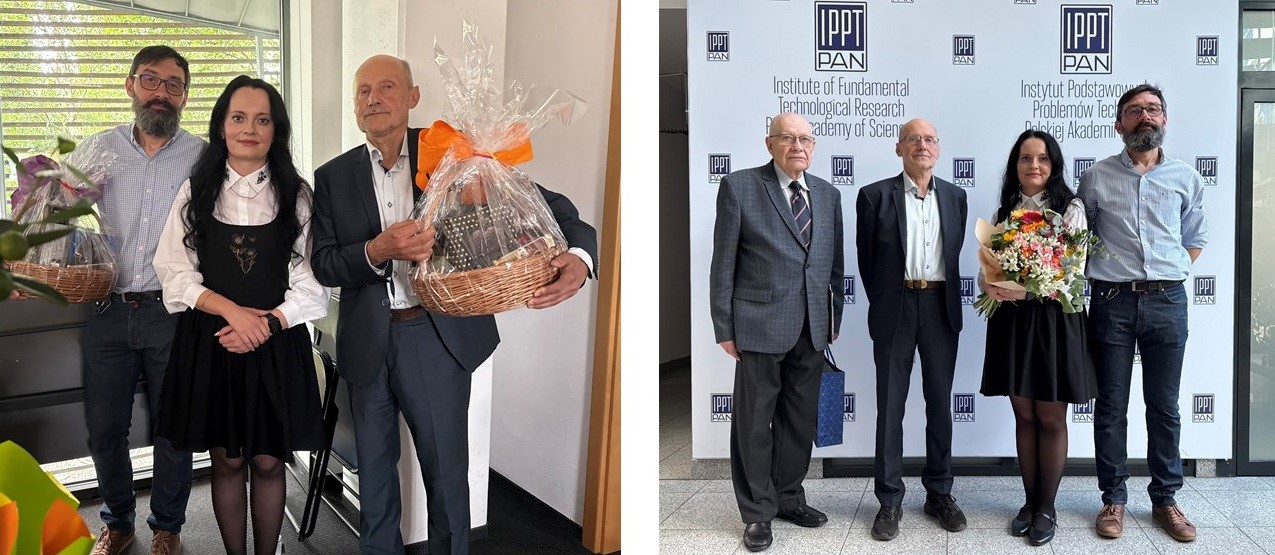
We are pleased to announce that the Scientific Council of the IPPT PAN has awarded Angelika Zaszczyńska the degree of Doctor in Engineering and Technical Sciences, in the discipline of Mechanical Engineering. The title of the doctoral dissertation was: “Piezoelectric Polymer Nanofibres as Smart Cell Substrates for Tissue Engineering Applications.” The dissertation was defended with distinction.
The dissertation was supervised by Prof. Paweł Sajkiewicz, with Assoc. Prof. Arkadiusz Gradys serving as assistant supervisor.
In this doctoral dissertation, comprehensive research was conducted on nanofibrous cell scaffold with piezoelectric properties, intended for applications in tissue engineering, particularly in the regeneration of the nervous and skeletal systems. The electrospinning process was developed and optimized, enabling the controlled fabrication of poly(vinylidene fluoride) (PVDF) and poly(L-lactide) (PLLA) fibers with piezoelectric hydroxyapatite (nHA) and gold nanoparticles (AuNPs) addition. A key aspect of the study was determining the influence of the molecular weight of the polymer, as well as the process parameters, such as collector rotation speed, solution feed rate and concentration of the polymer, on fiber alignment and morphology, piezoelectric properties, and biocompatibility.
The studies demonstrated that appropriate selection of electrospinning parameters allows for the formation of fibers with high uniformity and free from structural defects (e.g., beads), while simultaneously enhancing their ability to generate electrical signals. Structural analysis using FTIR, WAXS, and DSC enabled the identification of key relationships between the molecular structure of the fibers and their functional properties. It was shown that the introduction of additives, such as piezoelectric nHA and AuNPs, significantly influences the content of piezoelectric phases, crystallinity degree, and polarization of nanofibers, leading to an enhancement of their piezoelectric properties.
Furthermore, a detailed analysis of wettability, surface energy, and water absorption was conducted, demonstrating that modifications in fiber alignment and the introduction of additives can improve biocompatibility. High wettability and increased porosity of PVDF and PLLA fibers with nHA addition promote cell adhesion and proliferation. The in vitro studies confirmed that the developed scaffolds exhibit no cytotoxicity and have the ability to support the growth of fibroblasts, osteoblasts, stromal cells and neural cells. Microscopic observations revealed that fiber alignment has a significant impact on cell organization and migration, suggesting the potential application of aligned nanofibers in tissue engineering, particularly in bone and neural tissue regeneration.
In summary, this study provides innovative solutions in the design and fabrication of nanofibrous cell scaffolds with high piezoelectricity, constituting a promising material for applications in bone and neural tissue engineering. The obtained results may serve as a foundation for further research on the application of nanomaterials in regenerative medicine, enabling the development of smart and bioactive implants that support the body's repair processes.