
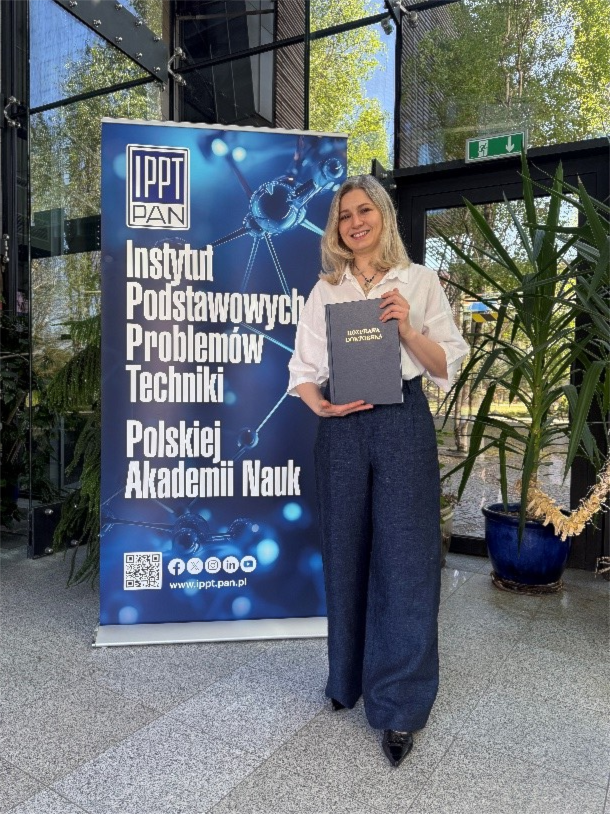
We are pleased to announce that the Scientific Council of the IPPT PAN has awarded Judyta Dulnik the degree of Doctor in Engineering and Technical Sciences, in the discipline of Mechanical Engineering. The title of his dissertation is: Biodegradable bicomponent polymer materials formed by electrospinning – influence of solvent, crosslinking, and functionalization on selected properties and cellular response
The dissertation was supervised by Prof. Paweł Sajkiewicz, with Assoc. Prof. Dorota Kołbuk-Konieczny of IPPT PAN serving as assistant supervisor.
This doctoral dissertation summarizes research on biodegradable bicomponent nonwoven materials formed by electrospinning, containing an aliphatic polyester and a protein additive – collagen or gelatin, intended as cellular scaffolds for tissue engineering. The scope of the research included investigating an influence of the solvent used for preparing polymer solutions for electrospinning, the crosslinking of the protein within the fibers, and the surface functionalization of fibers on selected properties of the resulting nonwovens, including the cellular response. One of the objectives was to develop a new, less toxic solvent system, as an alternative to the highly toxic fluorinated alcohols commonly used in electrospinning of this type of materials, which would enable to obtain nonwovens with morphology and properties comparable to those produced with conventional solvents. For this purpose, a mixture of acetic acid and formic acid was successfully applied. The observed emulsive character of polymer solutions based on this mixture resulted from weaker polymer-solvent interactions, leading to a different polymer chain conformation compared to solutions prepared with fluorinated alcohols. As a consequence, weak polymer-polymer interactions resulted in partial segregation of the two polymers in solution, which was confirmed by viscosity measurements. The rapid leaching of the protein additive under physiological-like conditions from bicomponent electrospun materials obtained using the new solvent system was a direct consequence of the emulsive character of the polymer solution. This observation served as the starting point for studies on crosslinking bicomponent nonwovens in order to improve the stability of the protein component and its bioactivity. As a result of comparative and optimization research of four chemical crosslinking methods applied to polycaprolactone and gelatin nonwovens, the fastest and the most efficient method was identified, and the optimal reaction times and reagent concentrations necessary to ensure the stability of the protein additive within the material were determined. The final part of the research focused on an alternative approach to obtaining bicomponent materials – not by electrospinning polymer blends, but by functionalizing the surface of an aliphatic polyester material with a protein. Three surface activation methods were investigated – alkaline hydrolysis, aminolysis, and cold oxygen plasma and their effects on the stability of gelatin immobilization as well as on a range of other properties of the resulting bicomponent materials were determined.